
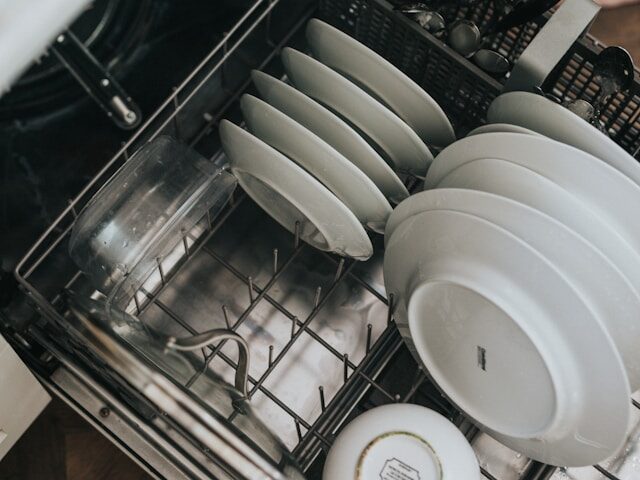
A dishwasher can clean hundreds of loads without much attention, but water quality can gradually affect how well it performs.
For homeowners in areas with harder water, mineral deposits can build up inside the appliance and on dishes, especially when maintenance and detergent use aren’t adjusted appropriately.
One of the most recognizable signs is cloudy glassware. If clean glasses develop a white or hazy film, mineral deposits may be involved. It doesn’t necessarily mean the dishwasher is broken.
Look at the spray arms too. Small openings can become restricted by mineral deposits or food debris, reducing the water pressure reaching dishes. If the machine seems to run normally but cleaning performance has declined, blocked spray arms are worth checking according to the manufacturer’s instructions.
The filter is another important area. A dirty filter can restrict water flow and leave food particles behind. Remove and clean it regularly if your model is designed for homeowner-accessible filter maintenance.
Detergent choice matters as well. Follow the appliance manufacturer’s recommendations and use the correct amount. More detergent doesn’t necessarily produce cleaner dishes and can contribute to residue problems.
Rinse aid can also improve drying and reduce spotting, although it won’t solve a mechanical problem.
Hard-water buildup becomes more concerning when the dishwasher starts showing other symptoms. A machine that isn’t heating correctly, takes unusually long to complete a cycle, produces persistent residue, leaks, or fails to drain may require professional diagnosis.
Don’t assume every performance problem is caused by water quality.
For example, a dishwasher that leaves food on plates may have a clogged spray arm, circulation-pump problem, blocked filter, insufficient water, heating issue, or control fault. A technician can distinguish between those possibilities.
The same principle applies to water softeners. If your home uses one, changes in its operation can affect the water entering household appliances. Keeping the system properly maintained can therefore benefit more than just drinking water and plumbing fixtures.
East Gwillimbury homeowners should also pay attention to older appliances. Mineral deposits accumulated over years can contribute to component wear, and replacement parts may become harder to source as an appliance ages.
If your dishwasher is still in otherwise good condition, repairing a specific failure can often be preferable to replacing the entire appliance.
For homeowners who need dishwasher repair services in East Gwillimbury, a useful service visit should begin with diagnosis rather than an automatic recommendation to replace the machine.
The best maintenance strategy is straightforward: clean the filter, keep spray arms clear, use detergent correctly, monitor performance, and investigate changes early.
Cloudy glasses may be a water-quality issue. A dishwasher that suddenly stops cleaning, draining, heating, or drying properly is a different matter.
Knowing the difference can save both money and frustration.
